Martin Söderberg interviewing Marius Vetrici
What aspects of AI resonated most with the participants during the SBF AI Early Bird Workshop?
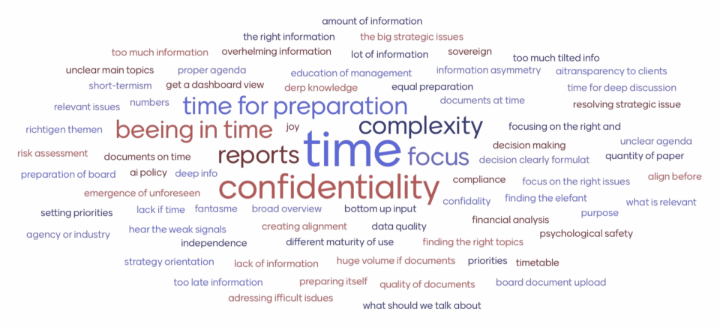
We opened our Workshop by asking participants to name their greatest pain point in preparing for a board meeting, resulting in a Cloud of Concerns.
The loudest signal was time: "time for preparation," "being in time," "too late information." Board members rarely get documents early enough to deeply reflect and ask sharp questions. So what landed hardest was the need for tools that could help regain that time: using AI to read, extract, and summarize lengthy board packs in minutes.
In short, participants responded most to AI as a way to buy back preparation time, do so securely, and sharpen strategic focus - the same needs they had voiced, unprompted, in the workshop's first minutes.
Do you see the need for using AI at the Board Level and if so, how?
Used well, AI is already a powerful ally in the boardroom, provided that Board Members understand both its power and its limitations. It is brilliant for generating perspectives, very strong for research on specific topics, and pretty poor when you need 100% accuracy. Kept within those boundaries, it becomes a genuine thinking partner. Boards can use it to stress-test their own ideas and assumptions, for example by asking, "Analyze this business concept and tell me why it would not work," and pasting the idea below. That single prompt can surface blind spots long before they become costly.
The need is clearest in two areas: cutting through information and scouting the outside world. AI can pull the top ideas from mountains of documents, though its output is just the start of the quest for essence, not the end. Board Members should always review the source material themselves for anything important the model might miss.
The risk of confidential information leaking through Cloud-based AI Tools is obviously a big concern. What would you recommend to reduce such risks?
The concern is entirely valid. Executives are rightly aware that sharing data with cloud AI carries real exposure: these systems may store our files, their employees or contractors may gain access to our data, while governments can compel the companies behind those clouds to hand data over.
The same logic applies to a company and its Board. If your most sensitive knowledge lives inside infrastructure you do not control, you have handed away part of your autonomy. So the confidentiality question is not only about avoiding a breach, it is about who ultimately holds the levers over your organization.
My recommendation is not to retreat from AI but to use it deliberately. Classify your data into three tiers: information that can never be shared, information that can be shared only once anonymized, and information that is already public and can be shared freely. And finally, for your most confidential work, invest in the computers and servers needed to run your own local, private AI, so the most sensitive data never leaves your control at all.
What do you see as “Must Haves” for a Board Member regarding AI Skills and Tools?
The first must-have is a mindset, not a tool: keep using AI, and use it responsibly.
Once that foundation is in place, a few practical AI skills prove especially handy for board work. The first is a Board Meeting preparation skill that reviews the documents in advance and extracts the key points. The second is an Agenda preparation skill that helps the board focus on the right issues and allocate time sensibly across them, keeping meetings on the topics that truly matter. Lastly, a red-flag AI skill that scans board packs and financial reports for inconsistencies, unusual figures, or missing information and flags the questions management should be asked.
And a private, local AI run on your own hardware is essential for confidential material: one that can analyze your sensitive documents and answer questions with precise references to the exact pages it drew from, giving you both confidentiality and traceable, verifiable answers.
For those interested in building these skills in a structured way, I have designed my AI Leaders course: a 13-week live online program for Board Members and Executives, not engineers, with no coding required, that has already trained 340+ leaders from organizations including Nestlé and UEFA, as well as through Hochschule Luzern. It runs one hour a week on Wednesday evenings from September 2 to November 25, and you leave with 14 ready-to-use business workflows and 7+ AI agents. You can see the full program at https://vetrici.com/aileaders/.
Many Boards worry about “Which most important topic isn’t even on our Agenda”. Do you think AI could help address this, if so, how?
I think the Board culture may be key to address this point. I would suggest making the use of AI part of the culture and to regularly let Board Members share their experiences of how they use AI for Board Meeting preparation. That could contribute to creating a positive and practical reinforcement through hands-on experience, increasing the chances of discovering blind spots.
What are your key Takeaways from the Workshop?
My first takeaway is that AI has already become a Board level issue, not just an operational one. This is a strategic theme, not an IT topic. The Cloud of Concerns, which our participants produced in the opening minutes made this vivid: their concerns clustered around Time, Focus, Complexity, Confidentiality, and Sovereignty. These are themes of importance for good governance.
My final and overarching takeaway is that the greatest risk is inaction. The path forward is a culture of disciplined balance of Learning and Experimentation: keep using and learning AI responsibly, treat it as a capable but fallible assistant whose output you always verify, and invest early so that managing complexity, protecting sovereignty, and staying competitive become strengths rather than worries.
Never let AI replace your judgement – it’s your personal responsibility!
About the authors
Marius Vetrici is an IT business executive with more than 25 years of experience in digitalisation and artificial intelligence. He holds a doctorate and a master’s degree in IT project management, advises organisations on digital transformation and GenAI implementation, and teaches AI masterclasses for executives.
Martin Söderberg is an independent advisor with experience of strategy development, transformation and corporate governance for multinational companies. He supports boards and CEOs in strategic decision-making, holds an MSc and PhD in physics from KTH Stockholm and an MBA from IMD Lausanne, and has been a Swiss Board Forum member since 2015.
Translation note
The original text was written in English. The French version was produced with the support of AI. In the event of any divergence in interpretation, the English version shall prevail.
Transparency note
This text was prepared by the authors and shortened to comply with the Swiss Board Forum Blog Guidelines with the support of generative AI.
Disclaimer
Dieser Artikel ist Teil der Reihe "Network Briefs", Reflexionen und Impulse von Mitgliedern des SwissBoardForum». Die Inhalte geben die persönliche Meinung der Autorin oder des Autors wieder und entsprechen nicht zwingend der Position des SwissBoardForum. Ziel ist es, aktuelle Fragen aus der Praxis von Verwaltungsräten aufzugreifen und unterschiedliche Perspektiven aus dem Netzwerk sichtbar zu machen: persönlich, relevant und anregend für die Mandatsarbeit. Die französische Version dieses Artikels wurde mithilfe eines Tools der künstlichen Intelligenz erstellt. Der Originaltext wurde auf Deutsch verfasst. Bei Abweichungen in der Auslegung ist die deutsche Originalfassung massgebend